
MATERIALS & TESTING · BUYER GUIDE
Do Plastic Outdoor Lights Become Brittle in the Sun?
A light can still look good after UV exposure. The next question is whether its housing and diffuser can withstand an impact.
Sun exposure can make some plastics more brittle. To assess that risk, look for an impact check after UV ageing. A test on a new housing tells you how it performed before exposure; it does not show how the same housing behaves afterwards.
Think about removing a diffuser for maintenance or handling a housing during installation. These are reasons to check mechanical performance as well as colour. A before-and-after photograph alone cannot answer both questions.
Sunlight can affect more than colour
Covestro describes deterioration of mechanical properties as one effect of direct UV exposure on unprotected polycarbonate. The material grade and its UV protection therefore matter, as well as the name “PC” on a specification. See the material manufacturer’s guidance.
Colour change and mechanical performance require different assessments. Q-Lab lists appearance evaluations separately from mechanical tests such as strength and impact. That is why an attractive before-and-after photograph should be accompanied by the appropriate mechanical evidence when impact resistance is part of your requirement. See weathering evaluation methods.
Our example: UV exposure followed by impact testing
Watch the order of events in Hengen’s laboratory video. The UV section records 1,440 hours of exposure. The following excerpt, 01:08–01:21.5, is labelled “IK06 impact test after UV test” and identifies PMMA, PC and ABS parts during the impact sequence.
The original video reports that the tested samples passed IK06. The clip provides a view of the procedure; the complete test record is needed to confirm specimen identity, test conditions and the acceptance assessment for an order. It does not establish an IK rating for every product in the range.
What does IK06 tell a buyer?
The IK code describes enclosure protection against external mechanical impacts. IK06 corresponds to an impact energy of 1 joule. It is an impact classification, not a promised number of years outdoors. IEC’s description of the IK code; IK energy table.
At about 01:17, the operator holds a white housing beside a handheld impact tool; the original label identifies the part as “ABS housing.” This is a component being checked, not a view of a complete installed light. Use that distinction when matching the video to a product you want to order.
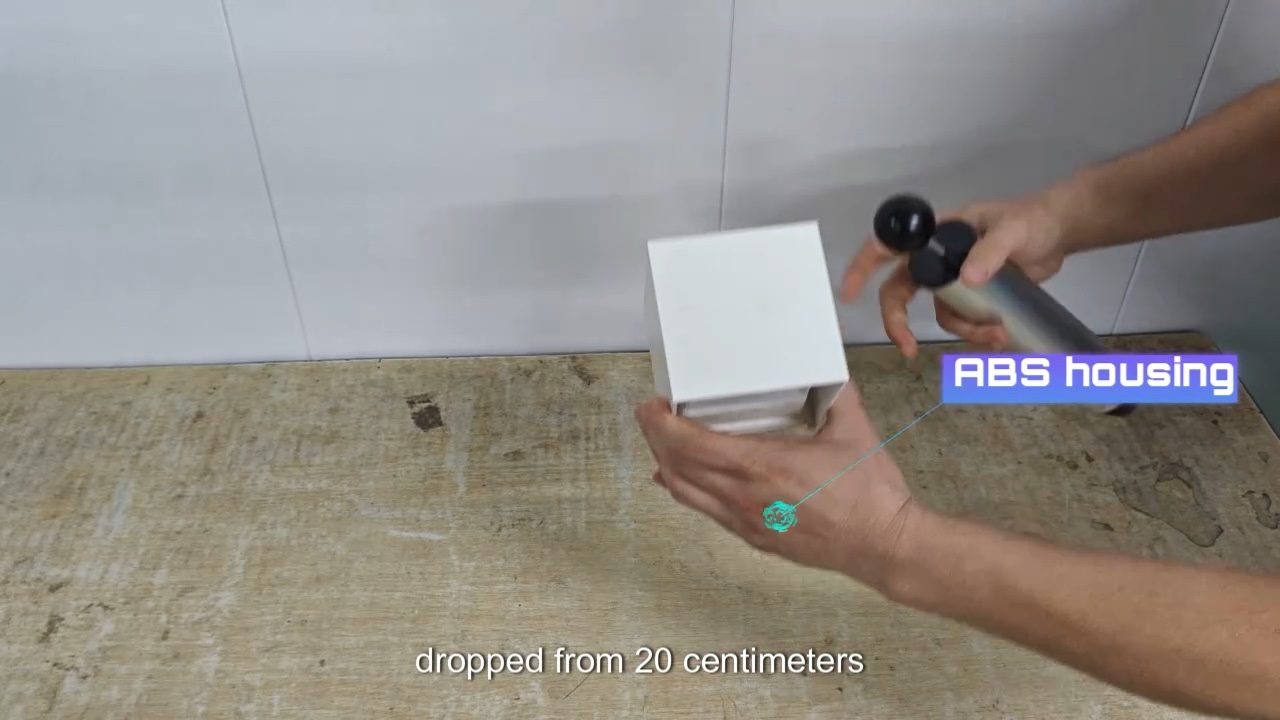
For an order review, trace three items: the specimen listed for UV exposure, the specimen listed for the subsequent impact test, and the recorded result. The video reports a pass, but does not show enough identifying detail to establish that link for every catalogue model.
Which record should accompany the clip?
| Buyer question | Evidence to match |
|---|---|
| Which component was tested? | Sample or model reference, material grade, colour and construction. |
| What happened before the impact check? | UV exposure duration and conditions, linked to the same specimens. |
| What impact test was applied? | Method, impact energy, sample mounting and assessment criteria. |
| What was the outcome? | Recorded observations and the result for the tested configuration. |
For the white ABS housing shown, request the specimen reference connecting its UV exposure record to its impact result. Then match the ordered housing to that reference. A changed material grade, colour or construction needs a fresh check of whether the result still applies.
Need to check a housing after UV ageing?
Include the housing or diffuser reference in your enquiry and say that you need the impact result after UV exposure. We can review which records are available for that part.
Request UV and impact records ↗