
MATERIALS & TESTING · BUYER GUIDE
Do Plastic Outdoor Lights Turn Yellow?
What to compare in before-and-after UV footage, and what to ask before ordering a white housing or diffuser.
Yes, some plastic parts yellow outdoors. A white housing and a clear diffuser can also age differently on the same light. Before approving a colour, ask to see the tested part beside its pre-test reference—not just a general claim of UV resistance.
For a retailer, the concern may be a replacement light that looks different from the fittings already installed. That makes the exact part and colour worth checking before the first order.
Why can two plastic parts age differently?
A material name is a starting point. For example, Covestro explains that unprotected polycarbonate (PC) can yellow under direct UV exposure and needs UV stabilisation for intensive exposure. See the material manufacturer’s technical guidance.
If the specification says PC, PMMA or ABS, ask which part it describes and which grade is used. For a white wall light, start with the white housing; a test on a clear globe cannot answer the same colour question.
A single light may contain several plastics. A result for its diffuser does not automatically describe its base, and a clear sample does not establish the performance of a differently coloured housing.
What did our samples look like after testing?
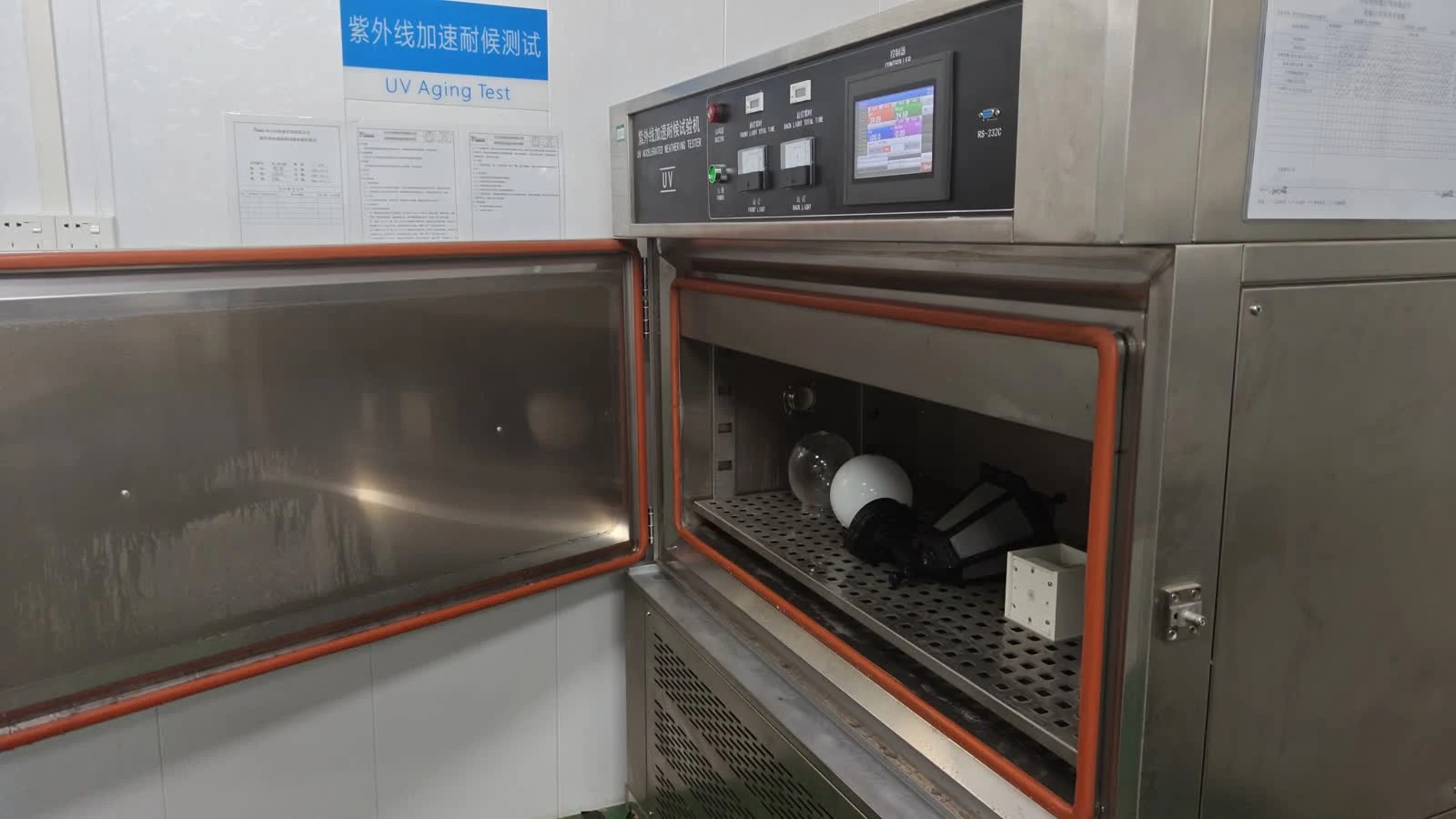
In Hengen’s existing laboratory video, a group of lighting components undergoes 1,440 hours—60 days—of UV weathering testing. The video then places the tested parts alongside photographs taken before exposure, including a globe, lantern body and white housings.
The recorded visual assessment describes minimal change, with no severe yellowing or cracks in the samples shown.
Pause the original video at about 01:05, shown in the frame below. The larger image is labelled “After testing”; the lower-right inset is labelled “Before the test.” Compare the white outer frame and lower strip with those same areas in the inset, then look separately at the central diffuser. Comparing a diffuser in one image with the housing in the other would mix two different parts.
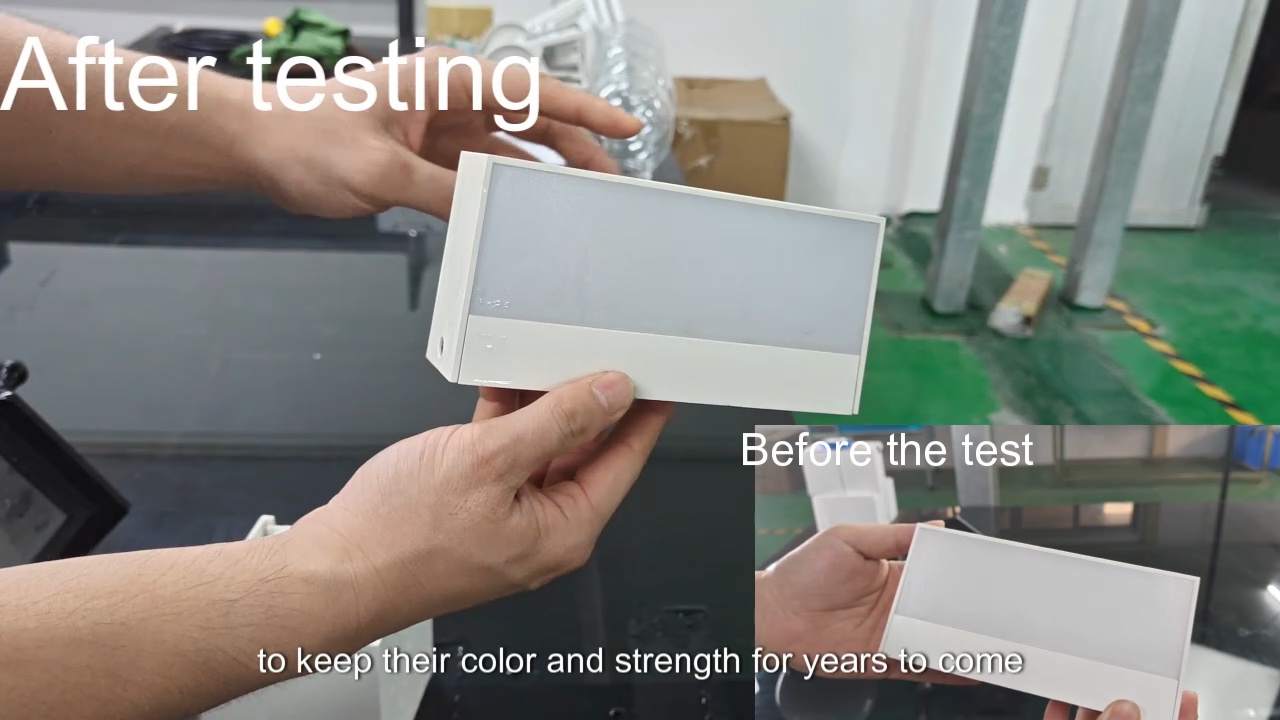
The white housing shown does not appear heavily yellowed in this comparison. However, the angle and lighting differ, so the images cannot give a measured colour difference. For your order, request the sample reference, material and colour used in the test, then check that they match the part you intend to buy.
Does 1,440 hours mean a fixed number of outdoor years?
It records the laboratory exposure duration. A conversion to outdoor years requires evidence connecting the material and test conditions with outdoor exposure. Q-Lab explains that there is no universal hours-to-years conversion for every material and environment. Read Q-Lab’s explanation.
Compare duration, conditions and results together. If a supplier gives an “equivalent outdoor years” figure, check the materials and exposure conditions to which it applies.
Before you approve the colour
| Check | What to match |
|---|---|
| Your product | Model, diffuser and housing materials, colour, and intended environment. |
| The test | Sample identification, duration and conditions that relate to the configuration being purchased. |
| The result | Before-and-after records, the evaluation method and the acceptable level of change. |
For colour-sensitive projects, agree an assessment method and acceptance limits before purchasing, and request the corresponding measurements. Visual checks under standard lighting and instrumental colour measurements provide different levels of evidence. See appearance evaluation methods.
Colour retention and impact resistance also need separate consideration. Our original video includes impact testing after UV exposure. That addresses a further question: can the weathered component still withstand an impact?
Choosing Materials for Outdoor Light Housings and Diffusers
Should the housing and diffuser use the same material?
Not necessarily. Identify each component and what it must do. The diffuser’s optical appearance, the housing’s construction and the expected exposure all form part of the specification. Review the selected combination and its evidence rather than asking one material name to describe the complete light.
Is “PC,” “PMMA” or “ABS” enough information?
No. Request the specific grade or material specification, colour, intended outdoor use and relevant results. For example, unprotected PC can deteriorate under direct UV exposure; the protection used matters. Material manufacturer’s guidance.
Can a result for the globe cover the plastic base?
Only if the evidence explicitly covers that base and configuration. Keep the test result connected to its actual sample. Do not transfer a globe’s appearance result or warranty to a different material elsewhere in the fitting.
Can one colour’s test result cover another colour?
Ask whether the evidence covers the selected colour and on what basis. Where the material specification or formulation differs, have that difference reviewed rather than assuming identical performance.
What should we agree before placing an order?
Record the materials and colours for the housing and diffuser, the approved reference sample, relevant test-document references and how changes will be reviewed. Use the same configuration in the quotation, specification and final order.
Checking a white housing or diffuser?
Tell us which part and colour you want to order. We can check whether the available UV records cover that choice.
Ask about colour and UV records ↗