
CEILING LIGHTS · BUYER GUIDE
LED or E27? Help Customers Choose a Ceiling Light
How to answer “What happens when it stops working?” and explain the trade-offs using one design with two light-source options.
“If this ceiling light fails, can I change the bulb, or do I need a new light?” For your customer, this is a question about future cost and inconvenience. Start there. Then show how replacement, light appearance and available settings differ.
The GD-PCL01-285 family gives you a useful way to explain the choice: the same exterior is offered with integrated LED or an E27 lampholder. An E27 fitting can also use an LED bulb; the distinction is an integrated light source versus a replaceable bulb.
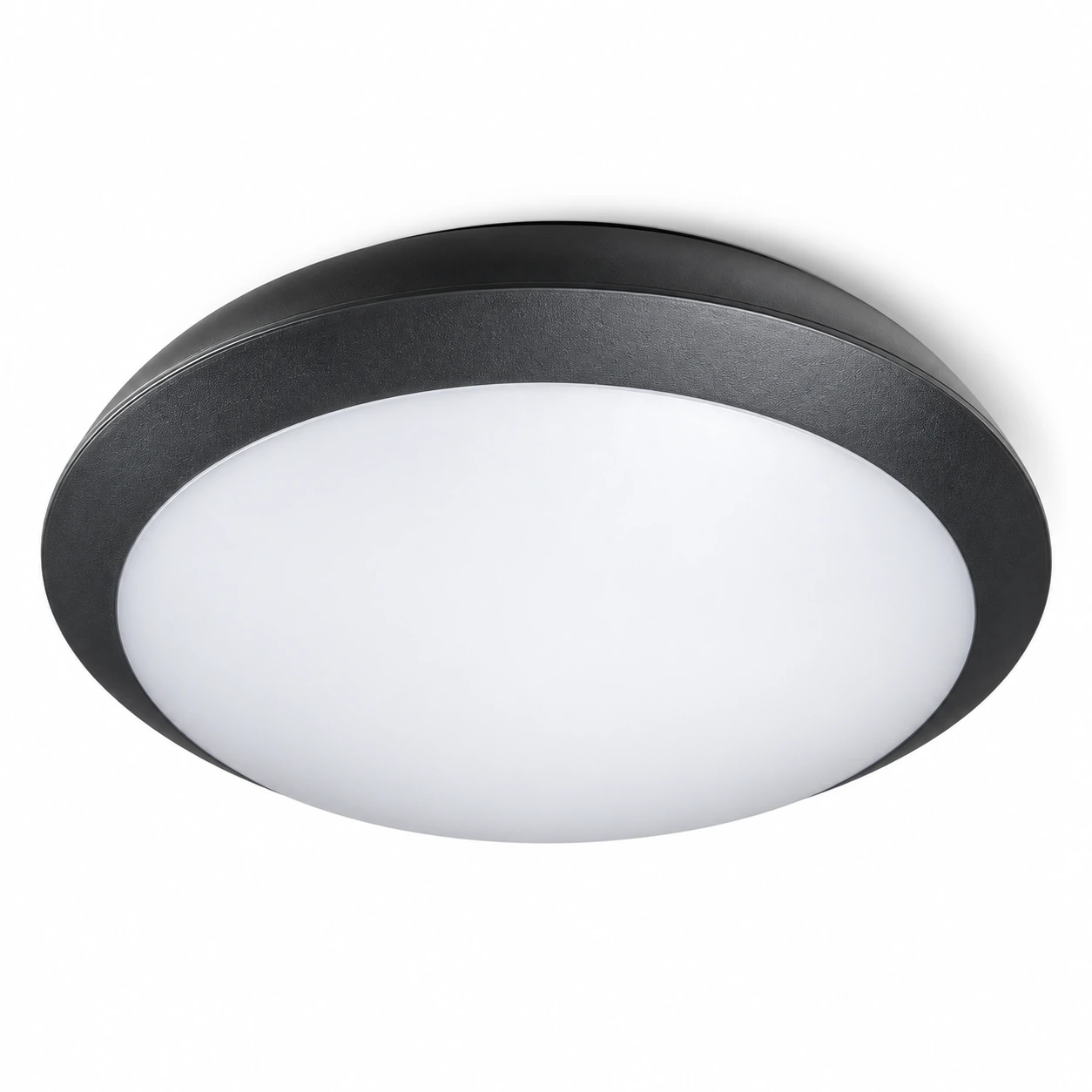
One design. Two ways to meet the need.
Integrated LED: 18W · nominal 900 lm · fixed-CCT and 3CCT versions listed.
E27: replaceable bulb · maximum 9W · output and colour depend on the bulb.
Both versions: 285 × 285 × 90 mm. Product image from the existing Hengen gallery.
“I don’t want to replace the whole light.”
When easy bulb replacement is the priority, introduce the E27 version first. If the bulb fails and the fitting remains sound, a compatible replacement bulb can restore the light. Select a bulb that fits inside the diffuser, stays within the fitting’s maximum wattage and is suitable for the enclosure.
“If you want to be able to change the bulb later, I’d recommend the E27 version. You keep the same exterior design, and a failed bulb can be replaced without changing the whole fitting.”
With integrated LED, there is no ordinary screw-in bulb to change. Some designs require replacement of the complete fitting when the light source fails; repair options depend on the construction, available parts and service arrangements. Before recommending a particular version, give the customer its actual replacement and warranty terms.
An E27 fitting can also offer a lower initial fitting price. Compare the fitting plus a suitable bulb with the complete LED version, so the customer sees the cost of a ready-to-use light.
“I want the whole diffuser to look evenly lit.”
Show the customer what is inside. The integrated LED version distributes its light sources across a broad circular board. The E27 version uses a single replaceable bulb, with a reflector around it to help distribute the light.


How the E27 reflector helps spread the light
For the E27 version, we developed a high-gloss white polycarbonate (PC) reflector. It surrounds the bulb and is designed to redistribute its light towards the diffuser, making the illuminated surface more even. The aim is to bring the E27 version’s light appearance closer to the uniformity of the LED-board version while retaining a replaceable bulb.
This gives your sales team a specific design feature to explain: the E27 option combines bulb replacement with a reflector designed to improve light distribution. The bulb and diffuser still influence the finished appearance, so demonstrate the complete fitting with the bulb you recommend.
“This E27 version has a high-gloss PC reflector around the bulb to help spread the light more evenly across the diffuser. You can still replace the bulb when needed. Let’s compare both versions switched on so you can choose the appearance you prefer.”
Keep uniformity and brightness separate. A smooth-looking diffuser does not by itself establish how much light reaches the space. Compare light output in lumens, together with distribution and installation conditions. Watts describe power consumption. An LED label alone does not prove that one fitting is brighter. ENERGY STAR explains the difference.
Two switches make the choice easy to explain
For a ceiling light with both adjustments, show the inside first. One selector changes the colour temperature; the other changes the power setting. The example below shows two separate three-position switches on an LED board. Customers can see what is being adjusted before comparing the light outside.
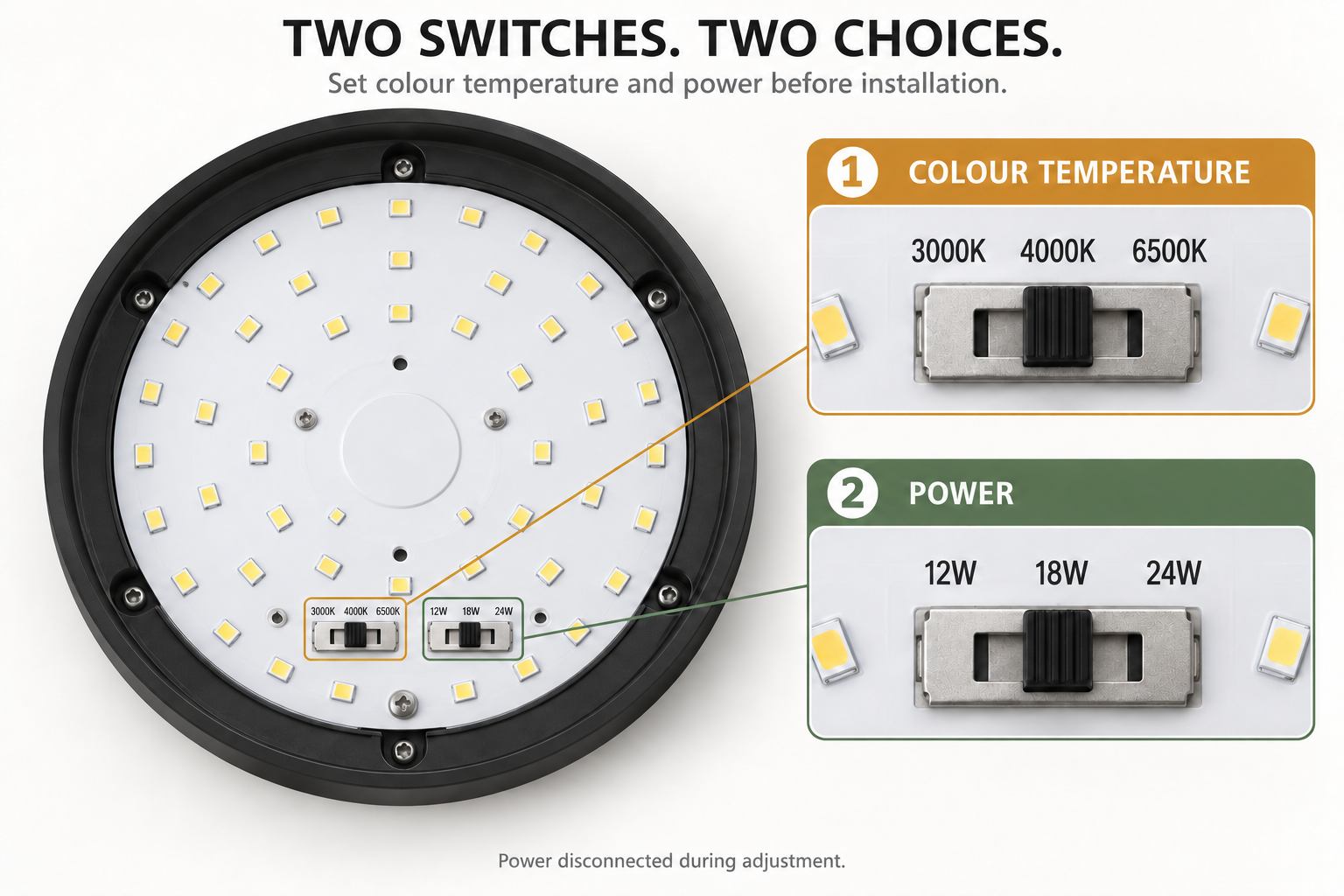
“On this type of adjustable version, there are two separate selectors inside. One chooses the light colour, and the other chooses the power setting. We can help you choose both before installation. These pictures show how the choices affect the light.”
Switch 1: choose 3000K, 4000K or 6500K
In this example, 3000K gives a warmer appearance, 4000K a neutral white, and 6500K a cooler white. Point to the colour-temperature selector, then to the corresponding exterior view below. Compare the colour at the same power setting so the customer can focus on the appearance they prefer.
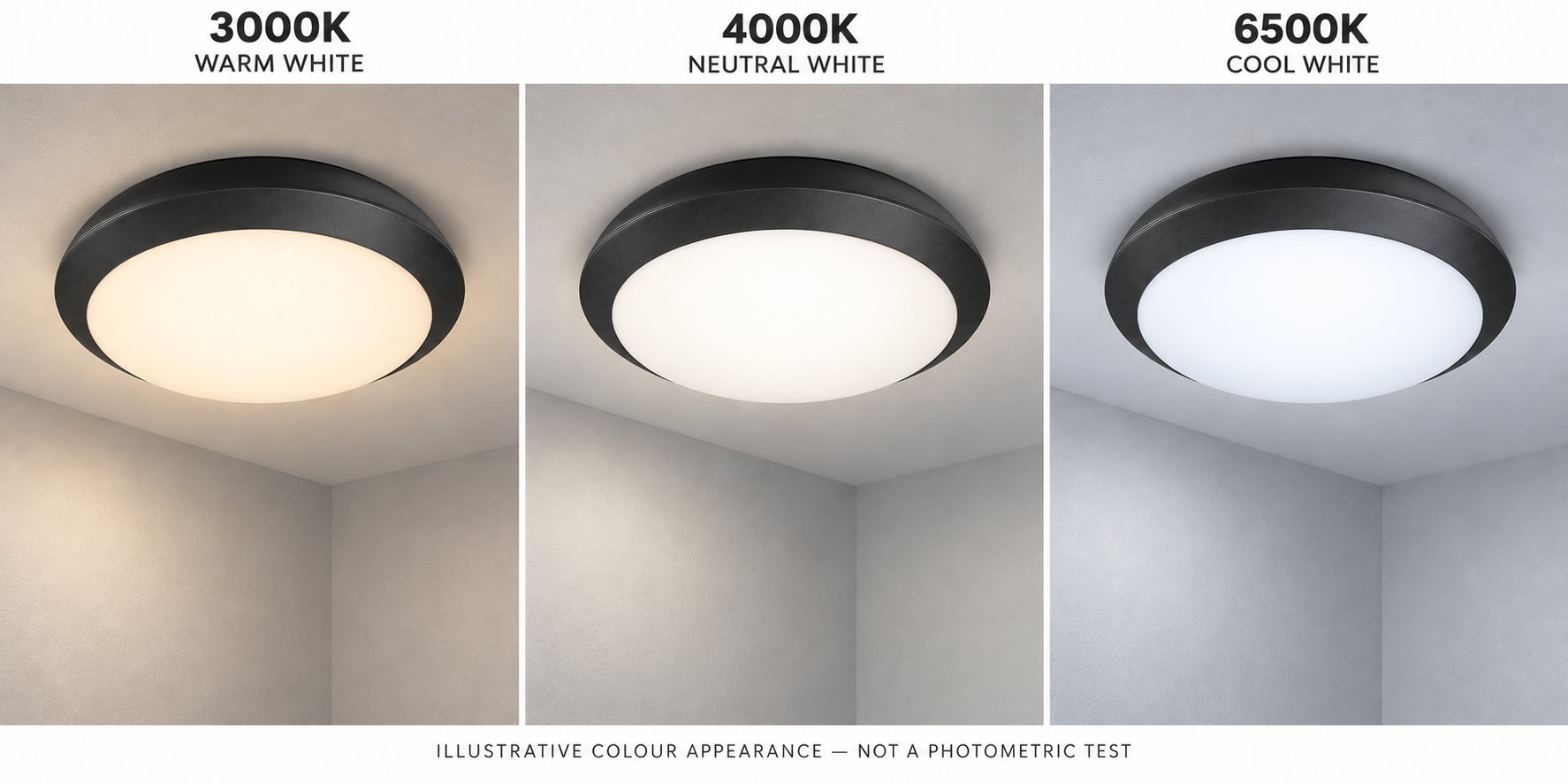
The GD-PCL01-285 range lists a 3CCT LED option as well as fixed-CCT versions. Match the settings on the supplied version to its quotation and packaging. With E27, colour is selected through the bulb you supply or recommend.
Switch 2: choose 12W, 18W or 24W
The second selector adjusts power independently of colour. In this example, the 12W, 18W and 24W positions are illustrated at the same 4000K colour temperature. This lets the customer compare softer, medium and stronger illumination without confusing a cooler light colour with more light.
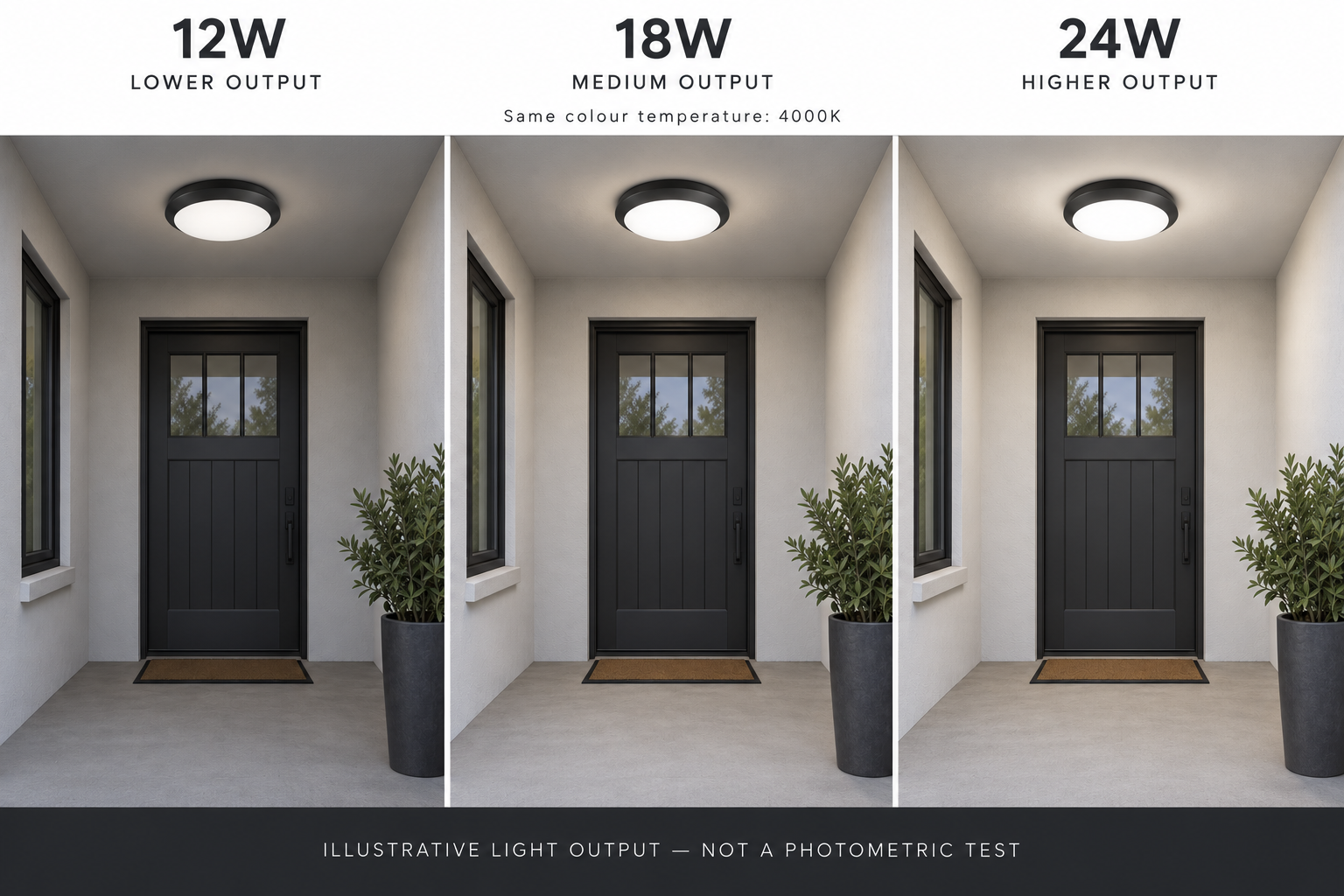
The installer selects the permitted settings before installation, with power disconnected and following the product instructions. These internal selectors do not automatically mean the light can be dimmed or have its colour changed from the wall switch.
Select the correct version: the board shown has both colour-temperature and power selection. The 18W / 900 lm figures listed earlier refer to the fixed-power specification; match the ordered version and its settings to the quotation and packaging.
Turn the conversation into a recommendation
| The customer’s priority | Your starting recommendation | What to explain |
|---|---|---|
| Easy bulb replacement | E27 version | Compatible bulb, maximum 9W, fit and enclosure suitability. |
| A smooth illuminated surface | Compare both versions switched on | Explain the distributed LED board and the E27 high-gloss PC reflector; demonstrate E27 with the recommended bulb. |
| Choice of light colour | 3CCT LED option, or E27 with a selected bulb | How the colour is selected and which settings are available. |
| Lower upfront cost | Compare complete E27 and LED prices | Include the bulb and compare the light the customer actually needs. |
For retailers and brands, offering both versions lets staff respond to different priorities within one exterior design. Display the distinction clearly: “replaceable E27 bulb” and “integrated LED”, with 3CCT identified only on the relevant version. Customers can then choose with a clear understanding of both the light they will see and what happens if it fails.
Offer the right choice in your ceiling-light range
Tell us which matters most to your customers: bulb replacement, light appearance, colour choice or entry price. We can discuss the GD-PCL01-285 LED and E27 configurations for your range.
Discuss LED and E27 options ↗