
CEILING LIGHTS · BUYER GUIDE
Selectable Ceiling Lights: Unit Price vs. Stock Cost
A slightly higher purchase price can still support a lower-cost range. The question is how much stock you need to hold—and what that stock costs you.
A supplier offers a ceiling light with three colour temperatures and three wattage settings. It costs a little more per unit than your fixed versions. Should you pay the difference?
Compare the extra purchase spend with the cost of keeping the existing range in stock. A selectable model may reduce the money tied up in slow-moving combinations, but the answer depends on your sales, replenishment plan and actual quotation.
First, compare products that can do the same job
The selectable GD-PCL01-285 LED configuration has separate switches for 3000K / 4000K / 6500K and 12W / 18W / 24W. One unit can be set to any of those nine combinations before installation, with the power disconnected.
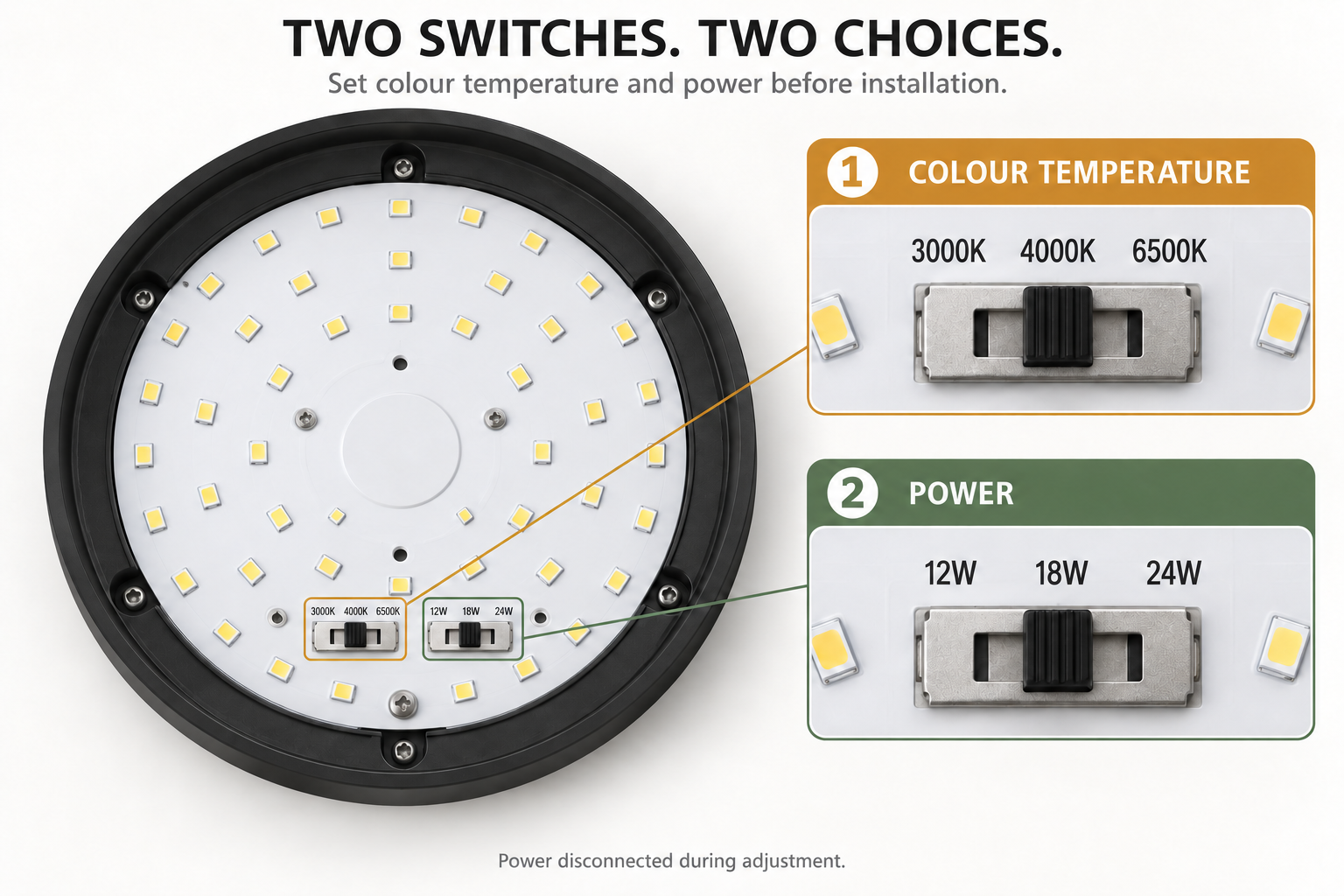
Check the housing dimensions, light output at each setting, control functions, market documentation and warranty. A shared housing must fit the installations it will serve. If customers still need a smaller fitting, keep that requirement in the comparison.
Then compare landed cost: the cost of getting each unit into your warehouse on the same basis, including the relevant freight and import charges. If the fixed versions have different prices, use an average weighted by the quantities you expect to buy. Comparing an ex-factory price with a delivered price will distort the result.
What does it cost to keep the fixed range?
The invoice is only part of the decision. Stock also ties up capital and can incur storage, handling, insurance and obsolescence costs. These are established inventory cost categories; the ASCM Princeton South Jersey explanation groups them into capital, service, space and risk costs.
With fixed variants, you may have stock of 12W warm white while an order for 18W neutral white goes unfilled. Compatible selectable stock can serve either order, so you may be able to reduce separate buffers and slow-moving balances. Signify describes fewer SKUs as a benefit of selectable lumen and colour settings; the amount of stock or cash you can save still needs your own calculation.
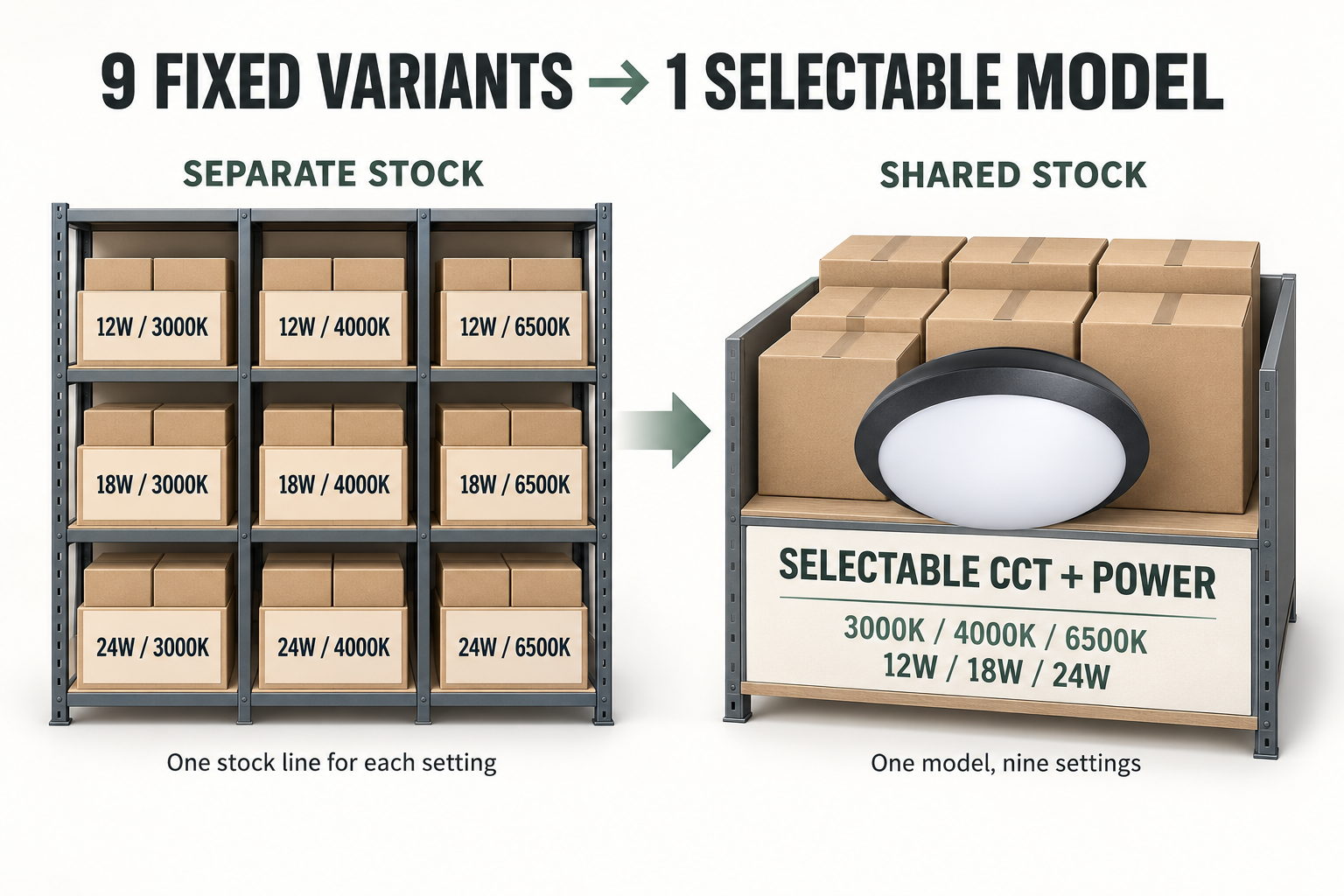
A worked example: does the price premium pay?
Suppose annual purchases stay at 6,000 units. The fixed range has a blended landed cost of 10.00 currency units per light, while the selectable version costs 10.20. You estimate that the new replenishment plan can reduce average stock value from 18,000 to 10,200, while maintaining the same delivery service.
For this example only, use a 20% annual carrying-cost rate. This is a calculation assumption, not an industry benchmark. Average stock value means the average value held over the year, at each option’s own landed cost—not annual purchases or retail selling value.
Try the purchase-and-stock comparison
Illustrative example only—not a Hengen quotation or a customer result. CU means currency units. Replace all six inputs with figures in the same currency.
Stock values are independent inputs. Recheck them after changing unit costs. One-time changeover costs are excluded.
| Annual comparison | Fixed versions | Selectable version |
|---|---|---|
| Purchase spend | 60,000.00 CU | 61,200.00 CU |
| Inventory carrying cost | 3,600.00 CU | 2,040.00 CU |
| Purchase + carrying cost | 63,600.00 CU | 63,240.00 CU |
Working capital difference; not an annual profit saving.
Purchase and carrying costs only. Positive means the selectable option costs less.
Annual carrying-cost reduction: 1,560.00 CU. Additional annual purchase spend: 1,200.00 CU. The selectable option costs 360.00 CU less per year.
Your figures stay in this browser tab and are retained when you switch language.
The example separates two benefits. The business holds 7,800 CU less in average inventory, and its estimated annual carrying cost falls by 1,560 CU. After the additional 1,200 CU of annual purchase spend, the advantage is 360 CU per year on these two cost categories.
Do not add the 7,800 CU working-capital difference to the annual saving. It represents less cash tied up once the lower stock level is achieved; it is not a recurring profit gain each year.
Annual advantage = reduction in annual carrying cost − extra annual purchase spend
A positive result favours the selectable option in this comparison. A negative result means the assumed stock saving does not cover the price premium.
If you change the unit price in the calculator, also update the associated stock value where appropriate. The two stock-value inputs are separate planning assumptions; the calculator does not predict how far your stock will fall. One-time changeover costs and other gains or losses are outside its result.
Build the estimate from your own range
- Measure the current position. Take comparable stock snapshots across the year and value each fixed variant at its cost. Review sales by setting, slow-moving units and missed orders alongside the average inventory value.
- Set a credible shared-stock target. Use combined demand, lead time, minimum order quantities and the same delivery commitment. Check the proposed quantity at the selectable product’s landed cost. Fewer SKUs alone is not evidence for a lower stock target.
- Use costs that can actually change. Build the carrying rate with your finance team. Lower stock may free space without reducing a fixed warehouse lease. Count storage or obsolescence savings only once, whether included in the rate or calculated separately.
- Include the switch-over. Allow for remaining fixed stock, packaging and catalogue changes, staff instructions and any setting checks during fulfilment. A larger common housing can also occupy more carton volume than the smaller lights it replaces.
Test the plan on one product family, then compare stock value and order fulfilment before and after. The selectable option is most persuasive when it keeps stock useful across more orders and the measured benefit covers its extra cost. A stable, high-volume fixed setting may still justify its own stock line.
Compare the cost of your ceiling-light range
Send us the versions and annual quantities you buy, together with your size and performance requirements. We can quote the selectable GD-PCL01-285 configuration so you can compare it with your current landed costs and stock plan.
Request a like-for-like quotation ↗